


Frequently-Asked Questions About Preparation for Veterinary School
Table of Contents
Which college/major should I enroll in?
What courses should I take?
What about animal experience?
What's the deal with contract seats?
How do I get more information?
Which college/major should I enroll in?
A student in any undergraduate college at Rutgers may enroll in the courses required for entry into veterinary school. Most pre-vet students at Rutgers are Animal Science majors at the School of Environmental and Biological Sciences (SEBS) on the George H. Cook camps in New Brunswick, though a student could elect a major in such diverse subjects as biology, chemistry, economics or even history. As long as the pre-professional core of courses is successfully completed, it is recommended that students also obtain as broad an education as possible and that they explore other interests and careers. This leaves open the option of pursuing an alternative career if it turns out that acceptance to a school of veterinary medicine is not something they really want to pursue.
Return to contents
What courses should I take?
Vet schools do not require a particular major, but they do require that a certain selection of undergraduate courses to be completed. The courses required differ among the vet schools in North America (US and Canada); however most require at least 2 semesters of biology, inorganic chemistry, physics, and organic chemistry, plus courses in biochemistry, math, statistics, and english. Check the current Veterinary Medical School Admission Requirements in the United States and Canada, published annually by the Association of American Veterinary Medical Colleges, or visit the website of the individual schools for their specific requirements.
What about animal experience?
Veterinary medicine is an animal-oriented profession, and therefore animal experience and vet experience is an essential component of the vet school application. Animal experience can be obtained in an animal shelter, farm or research setting-just owning a pet does not really qualify! All of the schools require that you also have extensive experience working with veterinarians, in clinical and/or research settings to be sure that this profession is "right for you". The Department of Animal Science incorporates hands-on experience with animals into the curriculum. The horse, swine, dairy cow, small ruminant and lab animal practica allow experience with daily care of those animals. The Animal Handling, Fitting, and Exhibition course enables students to work with a farm animal in a show setting as well as preparation of their animal for the show. The Seeing Eye Puppy Club give students the opportunity to learn how to care for and train puppies for the Seeing Eye. Students also may find positions as a veterinary assistant or other animal oriented jobs to complete their experiential learning requirement through Cooperative Education.
Acceptance to veterinary school (What's the deal with contract seats?)
There are only 29 veterinary schools in the US, and two states have two schools (California and Alabama). Most schools are state-funded, and therefore accept students mostly from their own state. New Jersey does not have its own vet school, but has "contracts" with other states to "buy" seats reserved exclusively for New Jersey residents. The schools receive a capitation fee for each “seat” in return for reserving a place in the incoming class exclusively for a qualified resident of New Jersey. This meant that NJ residents were only competing against each other, not the entire population of applicants at large, for the seats, vastly improving their changes for admission. Funding for these seats is allocated annually in the state budget and distributed to the contract schools by the Department if Higher Education Student Assistance Authority (HESAA). In the past (2000-2007) New Jersey had contract seats in 7 schools (University of Pennsylvania, Cornell University (New York), Tuskegee University (Alabama), Iowa State University, Oklahoma State University, University of Illinois, and Tufts University (Massachussetts)). However budget cuts for the past three years have resulted in the number of seats being cut to only 8 in 2008-2009 (3 at Tufts, 2 at Oklahoma, 3 at Tuskeegee).
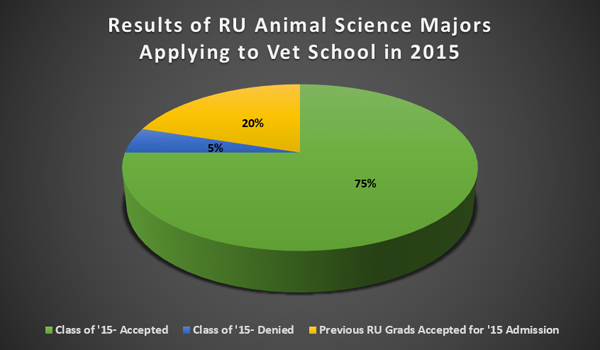
Qualified SEBS/Animal Science graduates over the past 10 years have had a success rate of 70% to 100% acceptance for those applying to veterinary schools, which is higher than the nationwide average of <50% acceptance for qualified students from states without a school of veterinary medicine.
For More Information:
Net-vetAssociation of American Veterinary Medical Colleges
Pre-Vet at Rutgers
For application information
For information on the contract seats
To register with the NJ Department of Higher Education Assistance to compete for the seats available
Contact:
Dr. Sarah Ralston
Pre-Vet Advisor
(732) 932-9404
ralston@aesop.rutgers.edu